
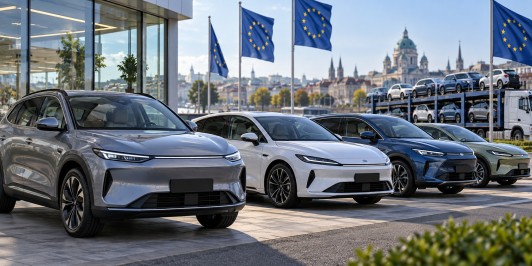
The European Union is grappling with a significant shift in its automotive market dynamics as sales of Chinese-made hybrid vehicles have witnessed a dramatic increase. This surge, observed amidst the EU’s efforts to balance trade relations with China and safeguard its domestic automotive industry, underscores the intensifying competition faced by European car manufacturers.
Between 2022 and the first seven months of 2026, the sale of Chinese-made fully hybrid cars in the EU skyrocketed from a mere 659 units to 160,662. Similarly, plug-in hybrid sales from China surged from 56,706 to 217,764 units during the same period. This growth trend accelerated after anti-subsidy tariffs were imposed on Chinese electric vehicles in 2024, as hybrid vehicles remained exempt from these tariffs, allowing them to carve out a more substantial presence in the European market.
In response to the burgeoning competition, the European Commission has approached China, urging a voluntary limitation on the export of hybrid vehicles to the EU. Should these discussions fail to yield an agreement, the EU may resort to implementing safeguard measures, such as potential quotas, to curb the influx of Chinese hybrids.
Chinese automotive companies like BYD, Chery, and Leapmotor are rapidly gaining traction, with Geely holding the position as the largest Chinese automotive group in Europe. BYD alone sold approximately 177,000 vehicles in the EU, reflecting a sharp year-on-year increase, while Geely’s sales reached about 205,000 in the first eight months of 2026. Despite these gains, European automakers still maintain the largest overall market share in the region.
The rising import of Chinese vehicles is occurring as hybrid vehicles now make up nearly 37% of the European car market, surpassing the market share of fully electric vehicles, which stands at just over 21%. This shift presents a challenge for the EU as it seeks to address its growing trade imbalance with China while protecting the competitive edge of its automotive sector.