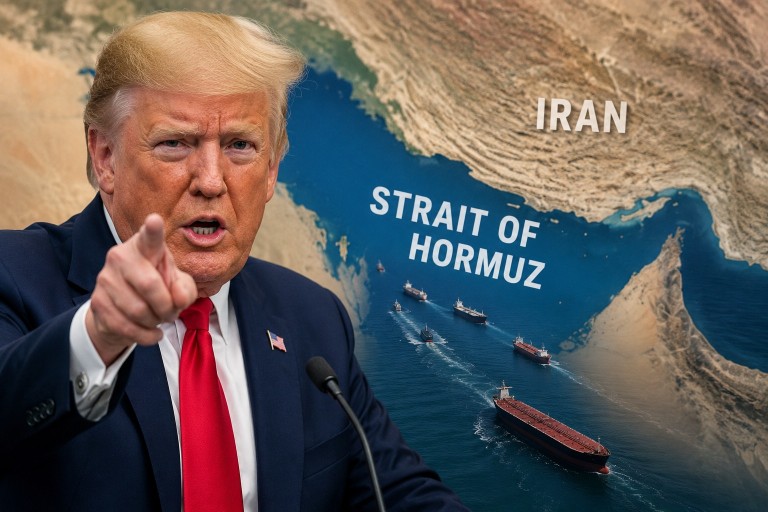
In a bold statement, US President Donald Trump suggested that the United States might soon declare the Strait of Hormuz as its own territory, amid ongoing tensions with Iran. This announcement was made during his address in New York on Friday, where Trump indicated that such a move would follow a victory over Iran. He asserted that the US already exercises control over this crucial maritime passage through an existing blockade.
The Strait of Hormuz holds significant importance as it serves as a key conduit for global oil shipments, with about 20% of the world’s seaborne oil passing through it. Situated between Iran and Oman, the strait has been a focal point of geopolitical tension, especially since the US and Israel initiated military actions against Iran, leading to its effective near-closure. Despite Trump’s remarks, it remains uncertain whether these comments signify a shift in official US policy or if they were primarily rhetorical in nature.
Iran has firmly dismissed Trump’s threat, with Deputy Foreign Minister Kazem Gharibabadi emphasizing that the nation will not succumb to American pressure, maintaining that Iran retains authority over decisions regarding the strait’s operational status. Furthermore, Iranian Foreign Minister Abbas Araqchi stated that Tehran has not opted to reopen diplomatic channels with Washington, noting that any messages relayed via Qatar and Pakistan fall short of formal negotiations.
Tehran has stipulated several preconditions for reopening the strait to shipping activities, including demands for compensation related to war damages, the lifting of economic sanctions, and access to Iranian assets that have been frozen internationally. The disruption in the strait has contributed to a rise in fuel prices, placing financial strain on consumers worldwide. President Trump defended the elevated prices, arguing that the increased cost is a necessary measure to prevent Iran from advancing its nuclear ambitions.
The ongoing impasse over the Strait of Hormuz continues to provoke anxiety over global energy security and the broader economic ramifications of the conflict. As the situation persists, the international community watches closely, aware of the potential consequences for global energy markets and the geopolitical landscape.