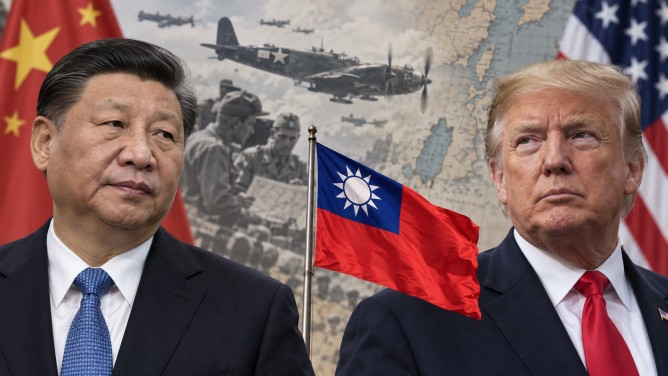
During a recent summit between U.S. President Donald Trump and Chinese President Xi Jinping, the leaders emphasized the cooperation between the United States and China during World War II. Trump praised the Flying Tigers, an American military unit that assisted China against Japanese air attacks, while Xi highlighted the joint efforts of the two nations against Japan. These comments have reignited a historical debate in Taiwan, where the government insists that the China which fought alongside the U.S. was the Republic of China (ROC), the government that retreated to Taiwan in 1949 following its defeat in the Chinese civil war.
The discussions have stirred concerns in Taiwan, as officials accuse Beijing of leveraging the wartime narrative to bolster its historical claims. Meanwhile, some opposition figures in Taiwan have criticized their government for seemingly distancing itself from the ROC’s pre-1949 history. This controversy underscores a longer-standing conflict between Beijing and Taipei over the historical narrative of China’s wartime legacy.
Analysts suggest that this renewed focus on World War II cooperation could complicate Taiwan’s efforts to carve out its own historical and political identity. The island’s government faces the challenge of maintaining its narrative while fostering strong relations with the United States, a crucial ally in the region.
The issue is emblematic of the broader geopolitical tensions in the region, where historical interpretations significantly impact current diplomatic relations. Taiwan’s predicament reflects its unique position in the aftermath of the Chinese civil war, where its identity and history remain contentious topics both domestically and internationally.
As Taiwan navigates these complex historical waters, the situation highlights the delicate balance it must maintain between asserting its distinct history and aligning with international partners. The ongoing debate over wartime history serves as a reminder of the intricate ties between past events and present-day international politics.