
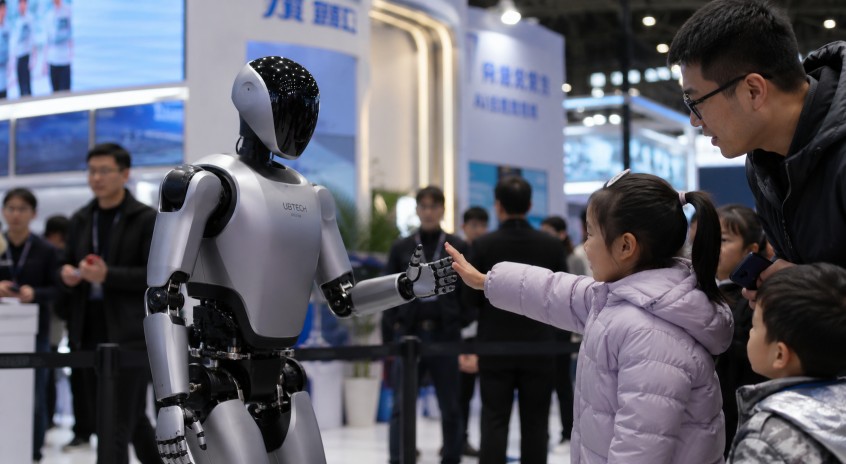
Over the past twenty years, China’s robotics sector has seen a significant evolution, transitioning from basic remote-controlled gadgets to sophisticated systems that can autonomously make decisions and collaborate in real-world scenarios. The industry’s journey can be traced back to 2007 with the introduction of the i-Sobot, a compact robot created in Dongguan, Guangdong Province. Despite its diminutive size, the i-Sobot was capable of executing roughly 240 different motions, including walking and climbing, signifying an early achievement in China’s foray into intelligent robotics.
From these initial experimental developments, China’s robotics industry has burgeoned into a dynamic field. Present-day Chinese robots boast artificial intelligence capabilities, allowing them to understand their environment, independently make decisions, and seamlessly work alongside humans across a spectrum of settings. This evolution is reflected in their increasing presence outside research environments, where they are now integral to sectors like manufacturing, logistics, healthcare, public services, and everyday life.
The deployment of these intelligent machines supports China’s broader economic strategy aimed at fostering “new quality productive forces.” This approach emphasizes technological innovation, increased productivity, and high-quality industrial growth. The integration of robotics into various industries is a testament to China’s commitment to leveraging advanced technologies for economic advancement.
The rapid advancements in China’s robotics industry underscore the nation’s growing investment in cutting-edge technologies. As robots become more ingrained in daily life and industrial processes, they play a crucial role in driving future economic expansion. China’s ambition to weave intelligent automation into the fabric of its economy reflects a strategic vision toward enhancing efficiency and productivity across the board.