
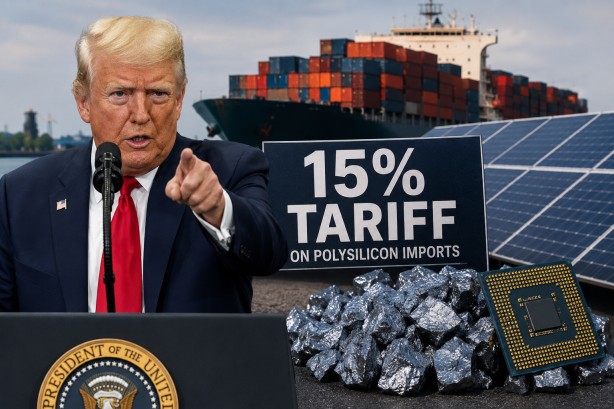
President Donald Trump has announced a 15% tariff on imported products made with polysilicon, a critical material in the production of semiconductors and solar panels. Set to be implemented on December 4, the tariff is part of a broader effort to bolster U.S. manufacturing and decrease dependency on Chinese imports. Polysilicon, known for its high purity, is essential in creating semiconductors for advanced technologies like artificial intelligence and for manufacturing solar cells and panels. Currently, China dominates the global market as the leading producer of this material.
Under the new trade measures, specific minimum import prices will be enforced, including $21 per kilogram for polysilicon, $100 per kilogram for polysilicon ingots and wafers, $0.22 per watt for solar cells, and $0.38 per watt for solar modules and panels. The U.S. government asserts that these actions are crucial to maintaining the commercial viability of domestic polysilicon production and reinforcing supply chains critical to both economic stability and national security.
China has expressed criticism of the U.S. decision, suggesting that the national security rationale is being improperly used to hinder Chinese business interests. The Chinese government warns that this protectionist stance could strain trade relations between the two countries, potentially leading to broader economic disruptions.
The United States currently hosts two major polysilicon production sites: Hemlock Semiconductor located in Michigan and Wacker Chemie in Tennessee. The new policy framework not only involves tariffs but also opens avenues for the U.S. government to incentivize companies to invest in domestic polysilicon production and related manufacturing infrastructure.
This tariff initiative arrives amid China’s robust growth in exports, especially in the sectors of electronics and artificial intelligence-related products, as well as other high-value manufacturing industries. By implementing these measures, the U.S. aims to stimulate its own industrial capabilities in these critical areas.