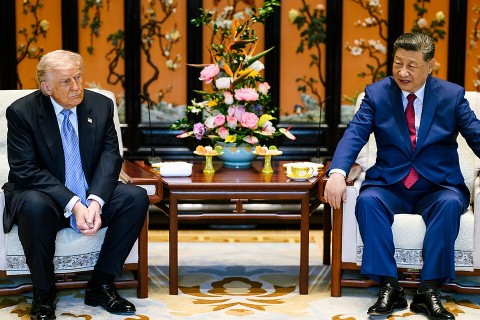
The government of China has issued a caution to the United States regarding the handling of Taiwan-related matters following former U.S. President Donald Trump’s announcement of his intent to engage in a conversation with Taiwan’s leader Lai Ching-te. Such direct communication between a U.S. president and a Taiwanese leader is particularly sensitive for China, given that Beijing views Taiwan as part of its sovereign territory and opposes formal international interactions with its officials.
China’s perspective on Taiwan is that it remains a renegade province that should ultimately be reunified with the mainland, potentially through the use of force. The Chinese government consistently objects to any foreign diplomatic engagement with Taiwan’s leaders, interpreting it as a challenge to its sovereignty. In response to these potential interactions, Chinese officials have cautioned against sending “wrong signals” that might embolden those advocating for Taiwan’s independence, viewing them as interference in China’s domestic affairs.
In recent years, tensions surrounding Taiwan have been on the rise. This was notably evident in 2022 when China initiated significant military drills around Taiwan following the visit of a senior American official to the island. Additionally, China’s disapproval has been evident in its reactions to U.S. arms sales to Taiwan and its political support for the island. Despite these tensions, Taiwan maintains that it is a self-governing democracy, officially known as the Republic of China, and it disputes Beijing’s claims over its sovereignty, asserting the right of its citizens to elect their leaders and engage in international diplomacy.
The policy of the United States officially aligns with the “One China” doctrine, wherein it diplomatically recognizes Beijing while simultaneously keeping unofficial connections with Taiwan. Under the Taiwan Relations Act, the U.S. also provides Taiwan with defensive military equipment. In a prior instance, Trump had a direct conversation with then-Taiwanese President Tsai Ing-wen in 2016, a rare occurrence that was met with criticism from China. Should Trump proceed with another call to Lai, it could exacerbate the already strained relations between the U.S. and China and potentially lead to a new wave of Chinese military maneuvers near Taiwan.