
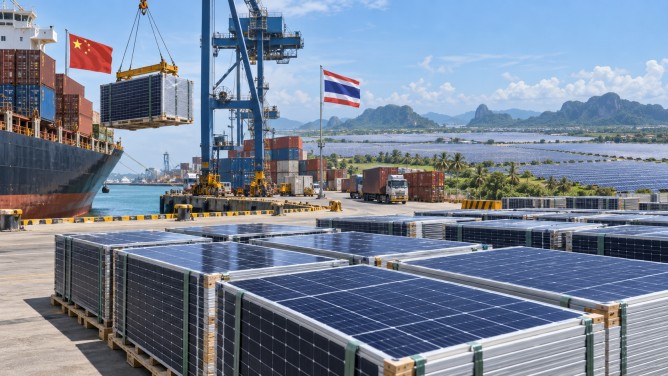
As Thailand ramps up efforts to boost its renewable energy sector, the country’s solar panel imports have witnessed a significant surge. Between January and July 2026, solar panel imports soared by 88.7% compared to the same period last year, reaching a value of US$426.7 million. This growth is largely driven by imports from China, which accounted for an overwhelming 99.3% of the total, according to data from Thailand’s Ministry of Commerce and Customs Department.
China’s contribution to this increase is substantial, with imports valued at US$423.9 million, marking a 107.1% rise from the previous year. In contrast, other suppliers such as Singapore and Hong Kong played a minor role, each comprising only about 0.3% of the total import value. This import pattern underscores China’s dominance in the Thai solar panel market.
The spike in imports coincides with Thailand’s preparations for a new household solar installation initiative. The government plans to offer subsidies of approximately THB50,000 per household, aiming to initially target one million homes with the potential to expand to 1.5 million. This initiative is part of a broader strategy to promote solar adoption, reduce electricity costs for households, and foster a robust domestic clean-energy supply chain.
In addition to encouraging solar installations, Thai authorities are exploring ways to enhance domestic solar manufacturing capabilities. Collaborations with the Ministry of Labour are underway to train workers in the skills needed for solar panel assembly, installation, and maintenance. Discussions with the Board of Investment are also being held to consider reducing duties on essential production inputs not available locally, which could further support the growth of the domestic solar industry.
Through these combined efforts, Thailand aims not only to increase the use of renewable energy but also to stimulate local economic activity and job creation in the clean-energy sector. As the country continues to advance its solar initiatives, the heavy reliance on Chinese imports highlights the importance of developing a homegrown manufacturing base to sustain long-term energy goals.